
ACE Spectrum
ACE Spectrum
Ace Spectrum is about you — the ACE Learning Centers.
It’s a quick sharing of ideas, inspiration, opinions and best practices among our continuing education organizations.
Please join the conversation.
Audio Academy is Part of the Golden Age of KALW’s News Department
By Guest Blogger Ben Trefny, News Director, KALW Public Radio and Geraldine Ah-Sue. Audio Academy ‘16
There’s been a lot of talk about the golden age of audio production. It’s all over the media, from New York Magazine, to the Columbia Journalism Review to the Telegraph. With an increasingly voracious audience, and a need for quality, meaningful content, the trainees in the Audio Academy are in a sweet spot right now. And they’re part of one of the best-sustained periods of quality work that KALW’s news department has ever had.
I don’t say that lightly, because we’ve had such industrious and extraordinary talent over the last decade. But I’ve been measuring the impact we make: both in audience we’re reaching; and in timely, significant stories that help shape our listener’s understanding of the Bay Area. And I think that for several months, really since this Audio Academy class started in mid-September, we’ve raised our journalistic game.
Here’s proof of concept from the last week as provided by people who have grown within KALW’s Academy and other training programs:
Holly J. McDede, who spent several summers training with our news department before settling recently in the Bay Area and finding paid work with KCBS, reported a remarkably timely story for us about the San Francisco police department’s crisis intervention training program. She had been working on the story before Mario Woods was shot by several police officers in the city’s Bayview District, providing the latest tragic example in the nation’s continuing concern over police use of force.
Angela Johnston (’14) reported on the Lehigh Cement Plant, which provides 90% of the cement used for Bay Area construction, with projects ranging from the Bay Bridge to Levi’s Stadium, while simultaneously writing a worrisome history of polluting its surrounding area.
Angela also reported an important, scene-rich story about the shutdown of this year’s dungeness crab season, the financial toll it’s taking on local fishermen, and what scientists think it means for the health of the Pacific.
In a companion piece that Angela edited, Hannah Kingsley-Ma (’15) traveled to the Farallones to tell the story of the rise in sightings of great white sharks in the Bay Area through the eyes and ears of researchers.
Liz Mak (’14) and Jeremy Dalmas (’14) aired the first installment of an immersive journalism project they’ve been working on called The Cutaway, by dropping listeners into the heart of San Francisco’s Cow Palace for the Cannabis Cup. They plan on releasing episodes as a podcast in 2016.
Jeremy also took a pre-dawn ferry ride to Alcatraz Island to tell the story of a Native American ceremony in this Audiograph piece called Unthanksgiving.
And summer trainee Lezak Shallat continued to grow by putting together a story about San Francisco’s first LGBTQ history class.
Meanwhile, the foundational education that our Audio Academy is built on continues, with members of the current class getting schooled in two-hour training sessions from our engineers, this week, on using ProTools audio editing software. They have been putting that practice into production, creating audio montages of people identifying their neighborhoods, mixtapes of people sharing the songs that shape their lives, and Storycorps pieces that have been airing over the past several weeks. In early 2016, we’ll start bringing the Academy voices to our air as they produce their first feature assignments.
Here are some thoughts from Geraldine Ah-Sue about her experience so far in our program:
By Geraldine Ah-Sue, Audio Academy ‘16
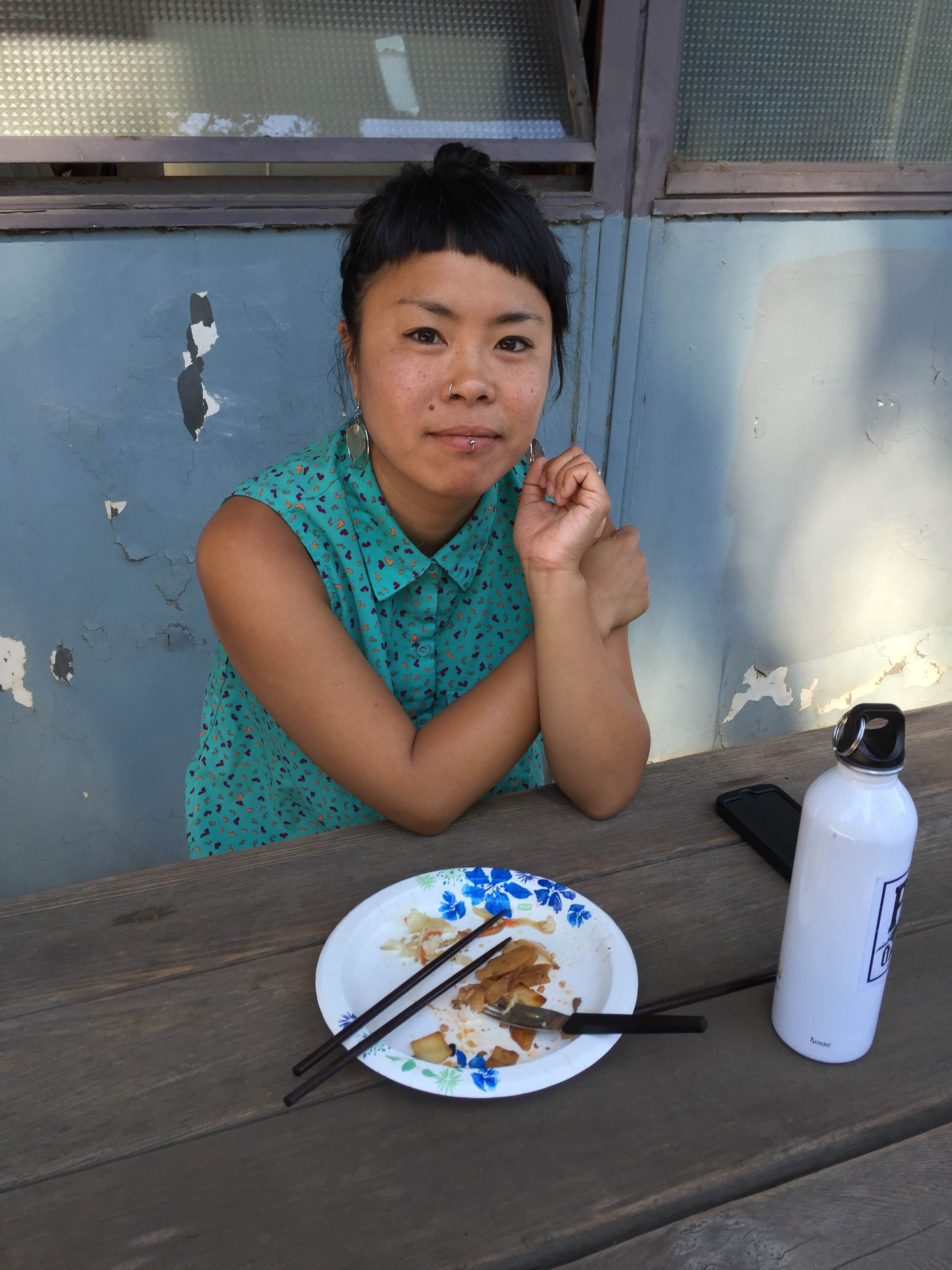
Geraldine Ah-Sue, Audio Academy ’16
Earlier this week, I was in what my new Crosscurrents family refers to as “The Fortress of Solitude.” This is where the sound engineers tend to spend most of their day. I was sitting with Ted, one of the engineers, and we were listening to my first hand at producing a Crosscurrents interview that was scheduled to air later that week. It’s an interview with Naomi Diouf, Artistic Director for the Diamano Coura West African Dance Company.
Before she came to the studio to record her interview, I visited one of Diamano Coura’s drumming classes as well as one of their dance rehearsals. I remember venturing out on those nights, not quite knowing what I was doing, but, being a young audio buckeroo, timidly bringing my recording equipment, quieting any lingering pangs of self-consciousness, and boldly holding out my microphone to record some sound. The drums, the dancing, the footsteps, the clapping, the singing, the laughter. I came home and instantly wanted to play back what I had just recorded – I was exhilarated.
Back in the Fortress of Solitude, as Ted and I listened to the mix of the interview, I found myself beaming with joy. I had never made something that sounded like that before, and I liked what I was hearing! In the past, the most I’d do with mixing was maybe take a standard sound effect from youtube and overlay it with someone speaking. But with the Diamano Coura interview, everything I was listening to was real. It was the actual drummers, the actual dancers, the actual rehearsal, the actual Artistic Director. Everything was real, and it struck me that because of those elements, and by mixing them together, I was actually hearing Diamano Coura not just in sum, but in a full richness that is more like what someone might experience rather than deduce.
I am so excited to be part of the KALW Audio Academy. In applying for this program, I was really hoping to have an opportunity to learn more about my own “voice,” and through all of the amazingly creative and nurturing people around me at KALW, I feel like I’m on a structured and inspiring road to do so. I am constantly learning so much from everybody’s different styles of writing, reporting and listening, and I feel like my sponge sensory points are trying to absorb everything at all times. At KALW, there are so many entry points of knowledge and experience that I not only have access to, but that are actually welcoming me to ask, learn and in turn, make. New worlds open up with every new week that passes, and I am so excited to learn more about how to make what I hear in my heart into something real in the world.
Storytellers “Chase Something Meaningful” at KALW and San Quentin Prison to Tell Honest, Insightful Stories
By Guest Blogger Ben Trefny, News Director, KALW Public Radio and Truc Nguyen, Audio Academy ‘16
Hello! I’d like to start out with a note that’s outside of the purview of our Audio Academy. It involves a different training program we’ve been engaged in for several years, and a breakthrough event that took place over the weekend. It was a live storytelling event at San Quentin State Prison, arranged by the podcast Life of the Law.
The occasion was a coming together of the longtime, inmate-produced San Quentin News and the relatively newer San Quentin Prison Report, which trains inmates to report radio stories which are edited and aired by KALW. The event was made possible by podcast creator Nancy Mullane, who used to be an education and prisons reporter for KALW. It was a remarkably powerful, open, honest event, and I was really struck by how compelling the storytellers were and how vulnerable they allowed themselves to be. It made me extremely proud that our department’s work with the inmates has helped bring this kind of journalism to broader audiences; it’s clearly been very significant for them in their rehabilitation, and I think this sharing of stories will resonate with me and the others in attendance for a long time.
Back at the station, our Audio Academy members celebrated some significant debuts last week:
Chris Hambrick (’14) hosted the Sights & Sounds weekly broadcast for the first time, highlighting the best arts in the Bay Area, and we carried her conversation with Donna Sachet on Crosscurrents.
State prison, We also ran the first on-air story from Luisa Cardoza (’15): a Storycorps piece featuring former Audio Academy member Marcy Fraser (’14).
Jeremy Dalmas (’13) reported a really insightful story about professional video gamers, the fortunes they can make, the injuries they suffer, and the lifestyles they lead. It was part of a whole show package that included an archival student story from former Burton High School student and KALW trainee Lawrence Chan about the effect video games have had on his life.
Hannah Kingsley-Ma (’14) reported a very timely local/global story this week about reaching Syrians in refugee camps through a Skype connection in a temporary shipping container in central San Francisco.
Really, really impressive stuff. And now the current Audio Academy class is actively engaged with reporting their first features. Look and listen for them in January!
Here are some thoughts that Academy member Truc Nguyen (’15) would like to share:
By Truc Nguyen, Audio Academy ‘15
Getting an acceptance call in May from KALW’s Audio Academy was like starting a relationship with a long-time crush. When the program began in September, the honeymoon phase was strong. The first few dates in the studio felt like magic.
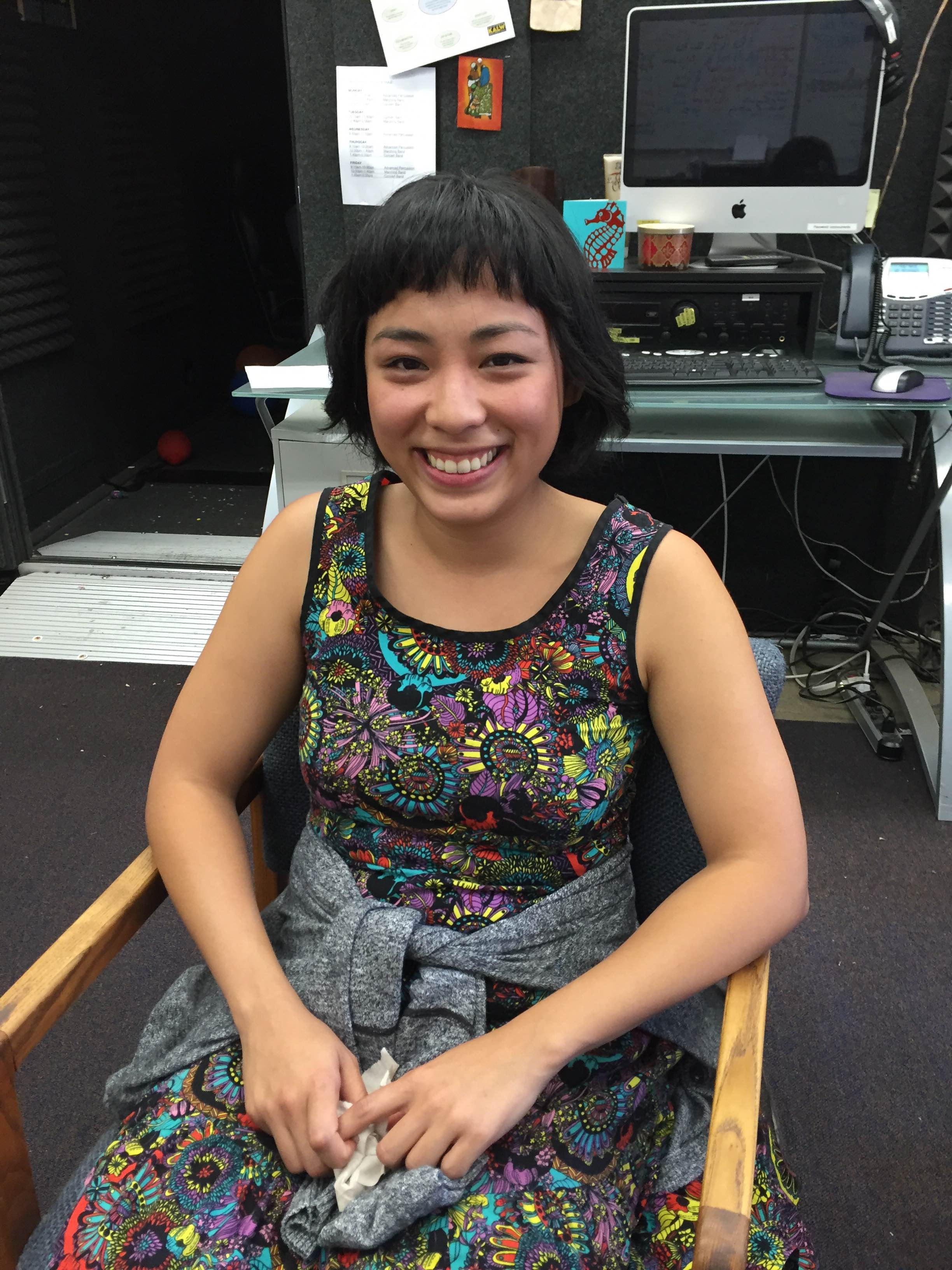
Audio Academy member Truc Nguyen.
The long muni rides from the Lower Haight to Visitacion Valley, just glorious. Chasing the crowded 9 San Bruno down and then visibly sweating the entire way just meant I was alive. Food and sleep? Didn’t need it. New love was quite a drug.
The newsroom filled with kind, smart and genuine people, drew me in. While occasional dance parties broke out and chocolate o’clock came around, there was also serious work being done.
For the first time in life I had an official mentor, my very own trainer. Coach Jen Chien listened carefully to my projects and offered her input. Acute and precise, I got to see how a great mentor could elevate and push a person.
One Saturday I followed Leila Day out in the field at Pleasant Grove Baptist Church. The Church put on an event called Joyful Noise, inspired by a noise complaint from a neighbor, seen by many as another symptom of fast paced gentrification in the Bay Area.
Minutes into meeting up with Leila I sat in the backseat of a police car while she asked Oakland’s Chief of Police Sean Whent why he thought it was important that he was at this celebration. Reporting felt adventurous and seeing Leila wrangle in interviews encouraged me.
Later I talked with Gloria McNeal, a longtime resident of the area. I asked her what she hoped people could learn from this Joyful Noise celebration.
“To learn how to know one another, respect one another,” McNeal said. She paused for a moment before continuing, “Hmmm…I’m getting a bit emotional here.”
McNeal was vulnerable and I felt privileged.
About a month into the Audio Academy, the drugs were still kicking but an old but familiar feeling crept in between the highs. This crush became a real live being and the stakes became apparent. Insecurities shouted. All my pants with a fitted waistband felt tighter. I began to doubt my presence in the Audio Academy. I questioned every comma and creative choice, which made my skin chronically itch. All these people are putting so much energy into helping me grow but will I live up to it?
A seminar on sound with Angela Johnston, former Audio Academy member and now full timer at KALW, reminded me why I applied to this program in the first place. We talked about what kind of sounds I could collect on my first place profile and there it was, the fun. Angela also reminded me that learning was the focus, not being perfect.
Maybe this is just how it feels to finally chase something meaningful and maybe a little bit of fear is okay, even necessary. I can let it take me down like I have in the past or I could think of it as a positive thing. Like any dynamic relationship, this one may not be easy all of the time but it will certainly make life more interesting.
Literacy Classes at San Francisco International High School Teach Reading and a Sense of Community
By Guest Blogger Vlada Teper, Literacy Teacher, San Francisco International High School
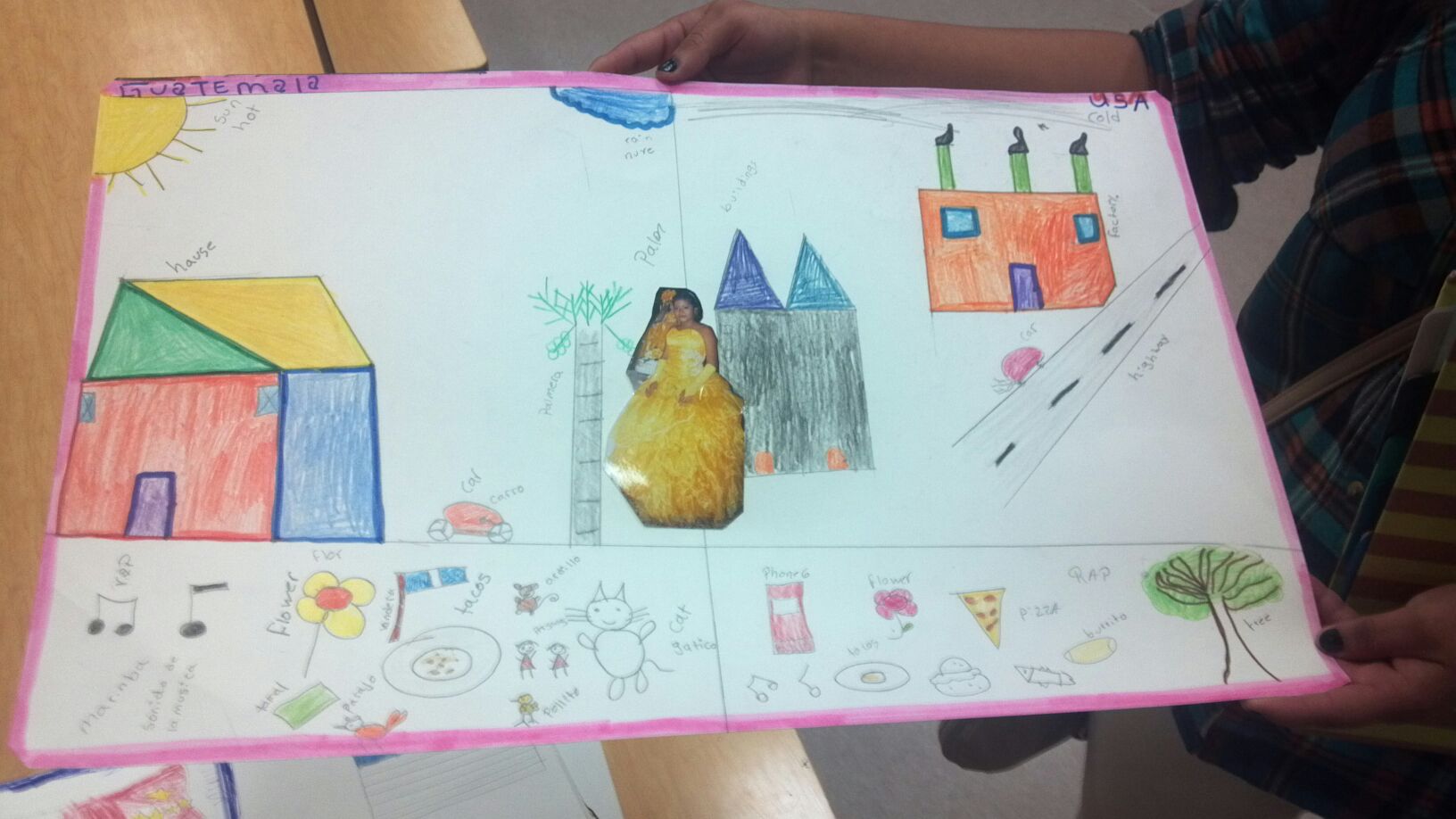
Here is a student’s work for a unit on Frida Kahlo’s “Standing on the Border Between the US and Mexico.”
San Francisco International High School (SFIHS) Literacy Classes include five sections, four sections of 9/10th graders and one section of 11th graders. Literacy Class empowers students not only to improve their literacy skills – reading and writing in English – and develop a student identity, but also to become advocates for their learning while developing a sense of community inside SFIHS and out.
The growth students have made in all the areas above is tangible. Students take turns leading classes, calling on peers to read class objectives, share opening answers and facilitate fluency practice. After a fieldtrip to the local public library, they now read books at home and know how to renew their books online. Two of the classes have seniors as TAs, themselves former Literacy Class students. Reyna and Hongwan don’t just give answers, either; they guide underclassmen to look for their own answers to questions.
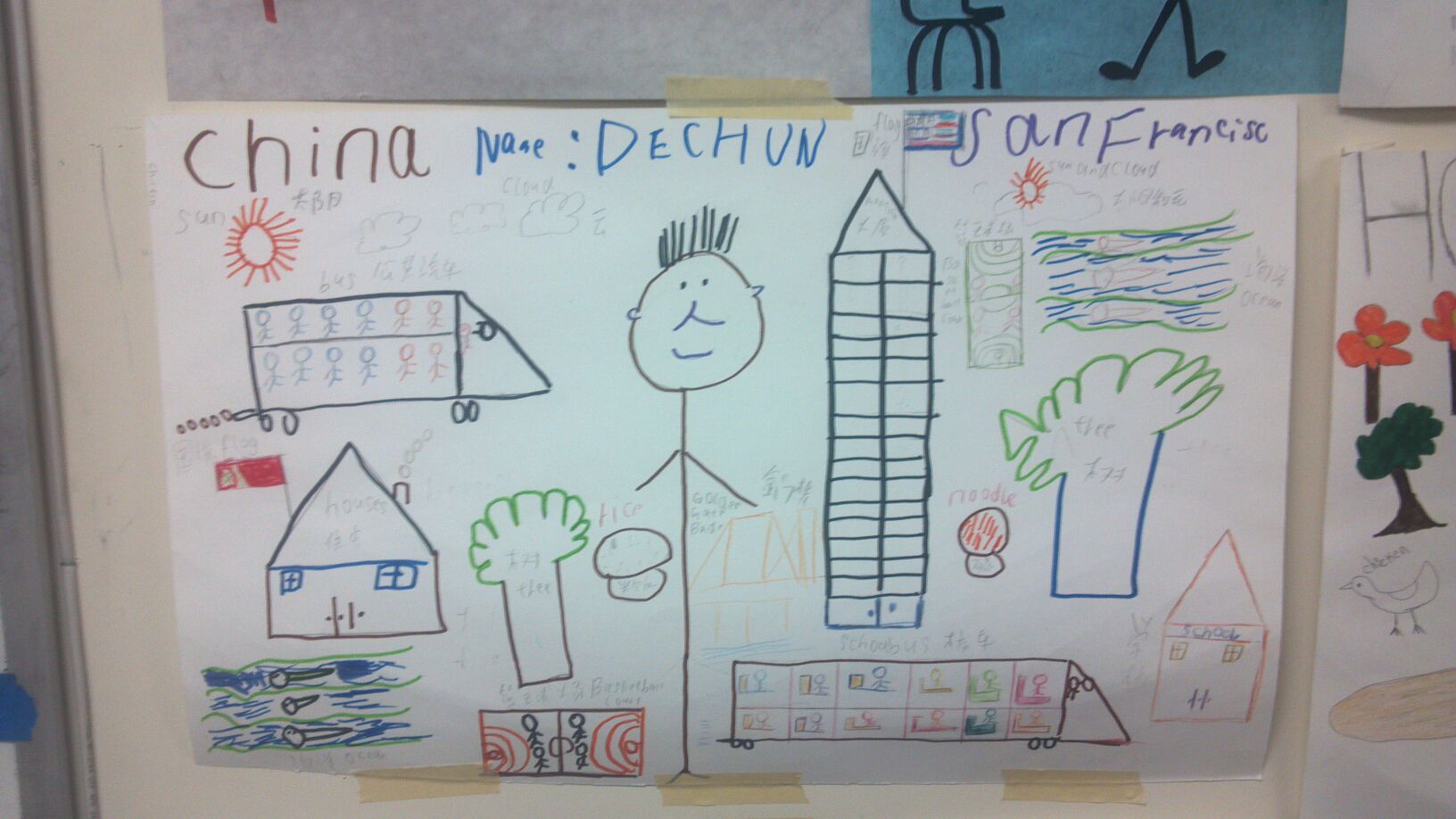
Another student art piece illustrates Frida Kahlo’s “Standing on the Border Between the US and Mexico.” The focus of the unit is what it means to bridge two countries, cultures and languages.
There is a palpable sense of community in the classes. When a student has been absent, others take responsibility for catching the student up, like helping with binder organization and identifying what work they are missing. When a brand new student starts the class peers jump in to translate, introduce the class and integrate the student into the community.
Literacy students have completed two projects and are now completing a third: letters to San Francisco Mayor Ed Lee proposing solutions to the housing crisis in the city. Recent immigrants to the US, the teenagers are becoming civically engaged members of the San Francisco Bay Area community.
Curriculum Note
By Kyle Halle-Erby, Span Program Coordinator, San Francisco International High School
Literacy classes fit in to SFIHS’s commitment to continuing education as our solution to remediation. Many of our students come to us with interrupted formal education. Many of these students are not literate in their first language and face increasing barriers to academic success in English. Literacy class provides a space for students to develop fundamental literacy skills, while still engaging in cognitively demanding, pre-college coursework.