
ACE Spectrum
ACE Spectrum
Ace Spectrum is about you — the ACE Learning Centers.
It’s a quick sharing of ideas, inspiration, opinions and best practices among our continuing education organizations.
Please join the conversation.
Walking the Growing Community with Oakland International High School
By Martha Sessums, President, ACE
I recently attended one of the yearly Oakland International High School (OIHS) Community Walks and enjoyed seeing the growth of the school, the focus on success by the high schoolers and the enthusiasm of the parents learning English at the ACE Parent Center. While ACE is only a part of what the school does, OIHS thinks big about providing quality education for recently arrived immigrants, and that includes their families.
From a start of 56 students when OIHS started in 2007, there are now over 400. They reflect today’s complexity of immigration with 25% being unaccompanied minors, 44% having a gap of two years without attending school and 100% English learners. There are more than 30 languages spoken in the school.
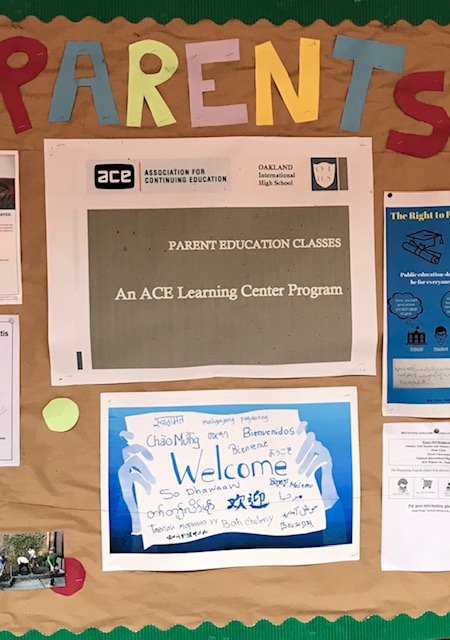
ACE Learning Center at OIHS.
The ACE Learning Center plays a part of English language learning in the community by instructing parents. Trish Malanyaon was the teacher I observed in the class and she led a group of parents in understanding how to talk about “places.” Looking at a picture, these adult students had to identify places like community centers, supermarkets and schools and discuss how places were correctly talked about, other names for them and how they were used.
Student Hanna often answered the questions first. But the lesson was also about the use of articles before nouns. The community center. The supermarket. The school. What comes naturally for English speakers didn’t come as naturally for Hanna and the other students. Many languages don’t use articles, so this was new.
I get it. I’m a student of the French language. While French uses articles, the nouns are masculine or feminine, and the articles must r, Learning Labeflect that. Le centre sociocultural (masculine.) Le supermarché (masculine.) L’école (feminine.) It’s not easy.
Ms. Trish was a firm yet delightful teacher who repeated the lessons in a fun, friendly way. The parent students were learning.
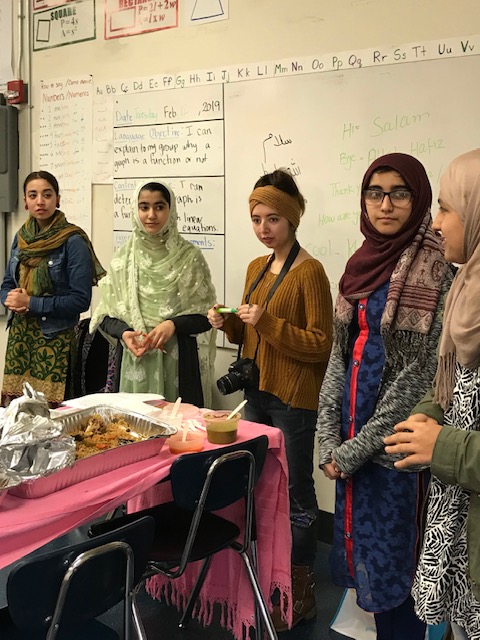
Afghan/Pakistan students answer questions during their Community Walk presentation.
There were four student-led presentations available, and I attended the Afghan/Pakistan group. A welcome lunch of sweet rice, a cheesy eggplant casserole and naan bread was served as five 12th grade girls taught us about their countries and how to spell our names in Pashto, an Afghäni language. Written from right to left, I was once again reminded how hard it is to learn a language that is totally different in structure and spelling. And I thought learning algebra was hard.
But Sailaja Suresh, one of the founding administrators at OIHS and now Director of its Learning Lab, believes there is a language and construct integration in learning.
“I was an algebra teacher,” she said. “Learning language and algebra together made students batter at math and language.”
The Community Walk group asked the students some of their favorite things and I was reminded that young learners are the same around the world. Several of the girls loved to play soccer, while others preferred reading. Favorite books ranged from Romeo and Juliet (both the graphic novel version and original Shakespeare) to Hunger Games. They also loved texting friends and watching movies. They were regular teens.
My Community Walk Day was a great blend of visiting the ACE Learning Center and meeting the Afghan and Pakistan students. Education comes in all forms and enthusiasms, and OIHS is using the best practices they have developed to drive learning and excellence. ACE is honored to be a part of the team.
In fact, it’s khob. That’s “cool” in Pashto.
It would really be khob if I could figure out x in the equation 5(- 3x – 2) – (x – 3) = -4(4x + 5) = 13.
“Catch ya on the Airwaves!” – KALW Provides Caring and Attentive Learning in Action
By Ben Trefny, News Director, KALW Listener Supported Public Radio and Maggie McKay, Audio Academy Fellow
I recently traveled around the Bay Area, dropping in on some of our out-of-office training programs.
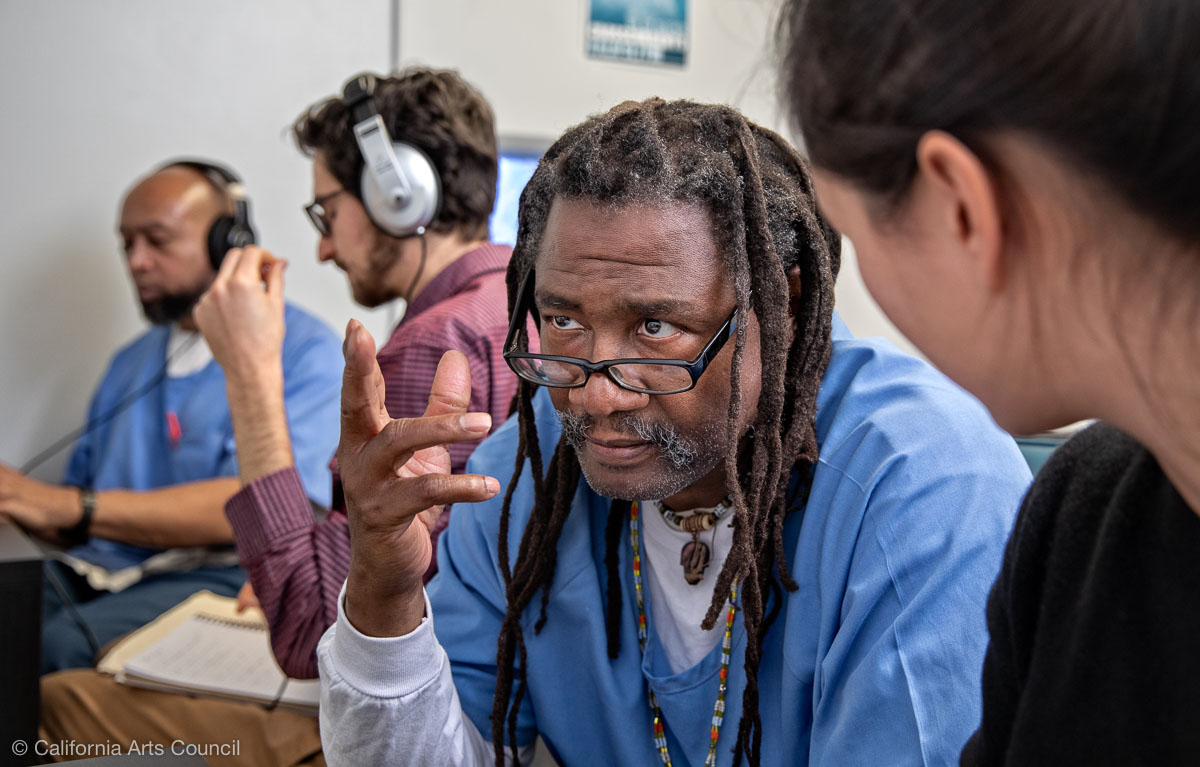
Uncuffed producer Spoon Jackson works with instructor Jessica Placzek while Brian Thames works with Eli Wirtschafter in the background – Credit: Peter Merts
First, on Friday, I joined KALW‘s transportation reporter, Eli Wirtschafter, at Solano State Prison in Vacaville, where he trains incarcerated men to produce audio stories that air on our station under the title Uncuffed. The program is situated in the media lab in the education department, where KALW has set up a makeshift recording studio and three editing stations. We worked with six guys, talking about how the program is evolving (and may end up on more stations), listening to a story our justice reporter made about a reunion of released citizens and prison guards on Alcatraz, and then editing pieces. The energy is really amazing, the students are extremely engaged, and it’s really a pleasure to work with the men and hear their stories.
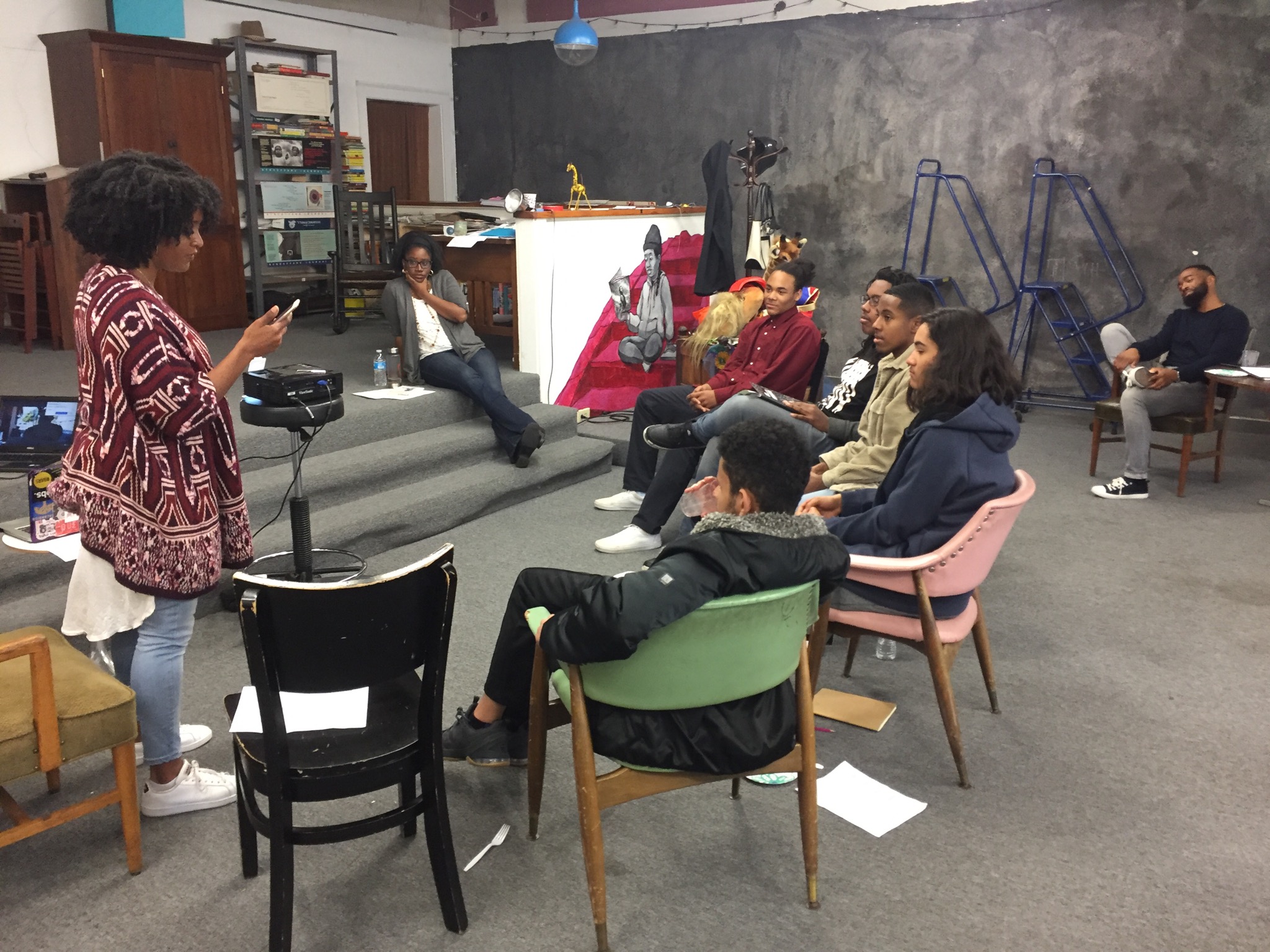
Ryan Nicole Peters works with students in the Black Joy writing program as part of Sights & Sounds of East Oakland.
Then, on Saturday, I went to Chapter 510 & the Dept. of Make Believe, where two members of our Sights & Sounds of East Oakland team, Jeneé Darden and Ryan Nicole Peters, led a workshop on public speaking and performance with a student writing group called Black Joy. Ryan and Jeneé are both accomplished performers and terrific teachers, and the students were rapt. Again, I felt very privileged to have the chance to see really caring and attentive learning in action, and I had the chance to enjoy seeing and hearing the students as they each took a turn on stage, performing their own works. They’ll be on a much bigger stage on February 24, when they take part in the Black Joy Parade in Oakland.
And now, as we like to do, we’re going to hand the mic over to one of the people learning from us. Here’s current Audio Academy fellow Maggie McKay:
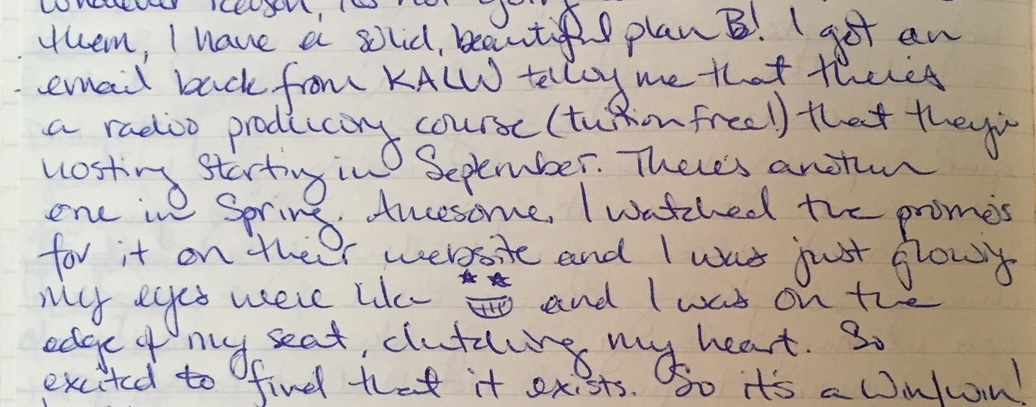
Maggie’s actual journal entry before she entered the Audio Academy – Credit: Maggie McKay
I learned about the Audio Academy a couple of years ago. I had reached out to the station to see about intern or volunteer opportunities, and they told me about the program. Here’s what I wrote in my journal: “I got an email back from KALW telling me that there’s a radio producing course (tuition free!) that they’re hosting starting in September. There’s another one in spring. Awesome. I watched the promos for it on their website and I was just glowing. My eyes were like “WOW” and I was on the edge of my seat, clutching my heart. So excited to find that it exists.”
You see, KALW has been “my station” for nearly 10 years. When I first moved to San Francisco in 2009, I quickly identified where all of the NPR affiliates were on the dial and programmed the pre-sets on my kitchen radio accordingly. KALW was in spot #1. And, aside from Saturdays, I rarely changed the dial (sorry bluegrass buddies!). KALW reverberated with me in a way that the other stations did not. Because I could feel that they were smaller. Scrappier. More local. More personal. More willing to discuss radical ideas because they weren’t tied to bigger interests. As I listened, I found a growing love for the format of audio storytelling. I also grew curious about the way radio was made. I started noticing when a sigh was meaningful, or when someone had made an obvious, awkward edit. Thus began my radio-making dreams.

Audio Academy fellow Maggie McKay – Credit: Ben Trefny
Fast forward to this year, when I was accepted into the Audio Academy. Upon arrival, I felt an immediate YES. All of the ethics and soul of the station that I had heard for years, that had inspired my dreams, they were all true! The smallness, the scrappiness, the local focus, the personal authenticity of each piece, the freedom to explore ideas … these qualities were all transmitted through the air waves accurately! I felt an embrace of hope and a sigh of relief that I had found the help — the leg up that I need on this journey.
Then came the challenges. The fear of failure. The self-doubt. Really? Can I actually call a source and describe myself as “a reporter at KALW Public Radio?” My mentor, Angela Johnston, said, “That’s just imposter syndrome!”
We’re now at the halfway point in the program. There’s less instruction and more just doing the damn thing. Winter break invited all sorts of funny feelings. Guilt because I wasn’t working on audio while out of town. Questions about identity. What am I doing here? Am I ever going to be good enough to support myself in this field? We talk about these things in our seminars, sharing our insecurities with each other.
Turns out morphing from one thing to another is difficult and painful at times! Following your dreams requires sacrifice and facing your fears. In the quietness after the holiday frenzy, I can hear a little voice inside of me asking, “Are you ready to embody your dreams, girl?”
Yes. I am! And only because I have support. The support that Audio Academy provides is real and tangible. It’s a pep talk from my mentor, a moment of vulnerability shared with another AA fellow, or a practical editorial suggestion from KALW’s incredibly talented team of reporters. I am so lucky to be here! And I’m ready to get back to work. Catch ya on the airwaves!
Span and LERN 51 Make Navigating College Easier for San Francisco International High School Graduates
By Elizabeth de Rham, Literacy Coach, San Francisco International High School and Karen Orellana, Span Student
One of the transformational programs of the ACE Learning Center at San Francisco International High School is Span – an advocacy and academic counseling program for recent graduates enrolled in college. Span Scholars meet as a group on their college campuses with the Span Coordinator and key on-campus personnel to build support networks that allow them to successfully complete college. This support is truly crucial to ensuring that our recent immigrant students succeed in college. The vast majority of our students are the first in their families to go to college, and all need help accessing the financial and academic resources that allow them to persist in their college education.
For the last two years, the Span program for students attending City College of San Francisco has been anchored by a credit-bearing class called LERN 51, taught by one of our Span Coordinators, on the CCSF campus itself.
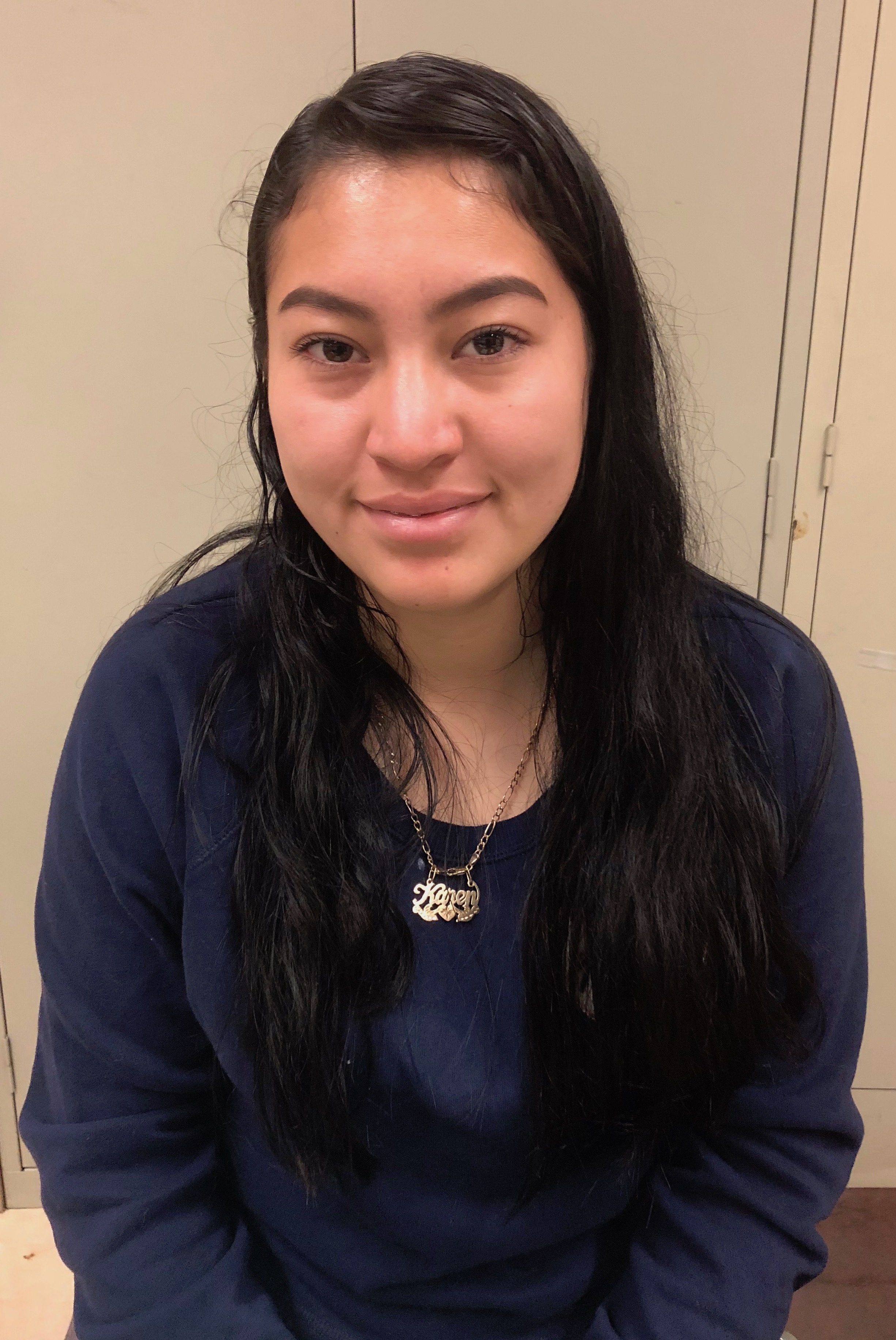
Karen Orellana, Span Fellow
Before Thanksgiving vacation we checked in with Karen, one of our Span students, to find out more about how Span and LERN 51 – all made possible by the ACE Learning Center at SFIHS – helped her start out strong on her college journey.
Tell me a little about yourself.
My name is Karen Orellana. I am 19 years old and I came from El Salvador in June 2015.
When did you start school at SFIHS? How did you feel when you first started?
I started in tenth grade. When I came, I was surprised to be in class with people from many different countries who spoke different languages from me. I felt afraid because I didn’t know if I had the capacity to learn English. How was I going to speak with people? How was I going to do my schoolwork? Everything was new: I was in a new school, I did not have friends yet, and all the systems in this country were different.
What did you think about college when you started at SFIHS?
I was interested in college, but I didn’t really think I would go because I didn’t know if I could. I didn’t know if I would be able to speak enough English or afford to pay for college.
What are you doing now that you have graduated?
I am taking classes at City College San Francisco. I am taking Child Development and two prerequisites: Math 70 and ESL 184. I am deciding whether to become a teacher or a guidance counselor.
What do you do in Ms. Oksana’s class (LERN 51)?
Ms. Oksana helps us figure out what classes to take, how to navigate the different class schedules, make sure we take the right prerequisites, and know when we have to register for different things. The class has also helped a lot making sure everyone knows the different degree options. Ms. Oksana invites someone from CCSF named Ms. Leti who explains scholarships, financial aid/FAFSA, Clipper Card, and all the things that make it possible to cover the expenses of being a student. We can also get individual advising during office hours after class.
How does the LERN 51 class make a difference to you and other SFIHS alumni?
It supports us with all the things we need to be successful in our first year of college. I can’t imagine trying to do college without it. I think if we didn’t have LERN 51, everything would be much harder, and some students would probably just give up on college. If I was alone, I would probably give up. There are a lot of expenses, and so much that is new and different. LERN 51 helps us with all of that.