
ACE Spectrum
ACE Spectrum
Ace Spectrum is about you — the ACE Learning Centers.
It’s a quick sharing of ideas, inspiration, opinions and best practices among our continuing education organizations.
Please join the conversation.
ACE Celebrates 50 Years of Supporting Continuing Education
 It’s been 50 years since the Federal Communications Commission (FCC) assigned radio spectrum as part of Instructional Television Fixed Service (ITFS), now known at the Educational Broadband Services (EBS), to ACE.
ACE’s mission hasn’t changed – deliver curriculum over its network to classrooms and workplace learning spaces. It’s the delivery network, the curriculum and learning spaces that have changed.
Originally, ACE broadcast distance-learning classes originating from its classroom in Mountain View to transmitting towers at Black Mountain above Palo Alto, and Mt. San Bruno north of South San Francisco. Instructors from Bay Area schools such as UC Berkeley and UC Santa Cruz would provide accredited classes. Area corporations such as Chevron, IBM, Motorola and Intel had established their own classrooms where the live classroom instructions were broadcast. Small antennas on the rooftop of the corporation’s facilities received the broadcasted signals and the antennas were then hard-wired or “cabled” to these classrooms. Engineers, business and medical professionals who attended these distance education classrooms would receive college credit for completing the courses.
Much has changed in 50 years. The network is now the internet, not a network broadcast from mountain-top cell towers to hard-wired lines that brought classes to a TV set. In an FCC approved agreement, ACE leases a portion of its licensed radio spectrum to Sprint and, in return, has access to Sprint’s wireless network. This agreement provides ACE Partner Schools and Learning Centers both on-site and mobile Internet connectivity.
Learning spaces are now wherever the internet reaches, from school Learning Labs to computers in the classroom, to students on computers or mobile devices at home. ACE helps meet today’s educational requirements by providing an available and flexible network.
Curriculum has changed too. ACE’s focus is to support ACE Learning Centers which provide community-based curriculum. This means curriculum focuses on the needs of the community. For example, the International High Schools in Oakland and San Francisco focus on the needs of immigrant students and their families in the Bay Area. Importantly, they get students through high school and into college, and offer support programs to help keep students in college. Immigrant parents learn English and computer skills to navigate through their new life, from reading bus schedules to college entrance requirements to understanding their rights as immigrants.
The Alpha Public Schools ACE Learning Center focuses on low-income Latino and Vietnamese parents. English is taught so parents can grow and succeed in their businesses and careers as their children who attend Alpha Public Schools are driven to graduate and attend college. They also added classes to help guide parents through the complicated college admissions process.
The Audio Academy at KALW Public Radio teaches community-based radio news techniques and it has grown into a role-model for journalism training in the public radio industry. In fact, graduates of the Audio Academy have created stories, podcasts or syndicated radio programs of which several have been nominated for or won industry awards. One graduate was nominated for a 2017 Academy award in Short Subject Documentary.
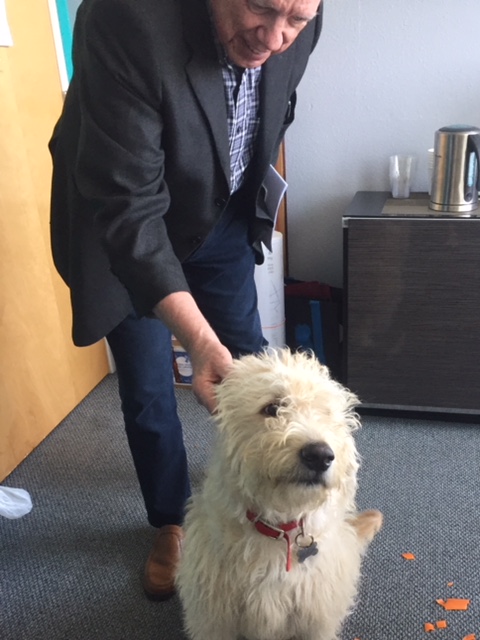
Philip Mustain, ACE General Manager, pets Thor, ODA Poetry Month Mascot. School Greeter too.
The ACE Learning Center at Oxford Day Academy (ODA) in East Palo Alto learned in its first year about meeting community needs. Leadership initially wanted to offer English classes for Latino and Islander parents but were told by the community that their priority was learning how to better navigate the educational system in their community.
According to Dr. Irene St. Roseman, ODA Head of School and ACE Parent Learning Center Director, “Our main objective is empowerment of parents, so they can engage the education system from a place of information and strength. They then take that information and use it to support their child.”
In classes, what that means is topics such as conflict resolution, data analysis and group management. Taught in a workshop fashion, the first year’s result was that two parents were elected to sit on the ODA board.
One of the ACE Learning Center workshops at ODA was a discussion on “How has Technology Improved Learning?” Some answers:
• Technology has given students great resources and new opportunities for learning by advanced techniques such as online resources and multimedia learning
• Technology helps us learn with our children
• Technology has improved learning … because … we can gain so much knowledge from around the world
• Google has improved my son’s ability to speak and learn
• Where parents can’t help, kids get help from technology
Technology, which has always been ACE’s base thanks to its radio spectrum that for 50 years has connected students to learning, is key to today’s – and tomorrow’s – learning. ACE thanks its Learning Center partners for continuing this ideal.
ACE looks forward to more years in supporting continuing education.
KALW Summer Internship Experience: Learning, Pushing Hard to be Successful, Creating Audio Stories and Those Cool Feral Cats
By Ben Trefny, KALW News Director and KALW Summer High School Intern Graduates
We’re rolling through the summer at KALW, working with more trainees than we’ve ever hosted before. Twelve adults and six high school students, all building their skills in our working newsroom. Today I’ll share a bit about our summer high school internship, which just wrapped up last Thursday.
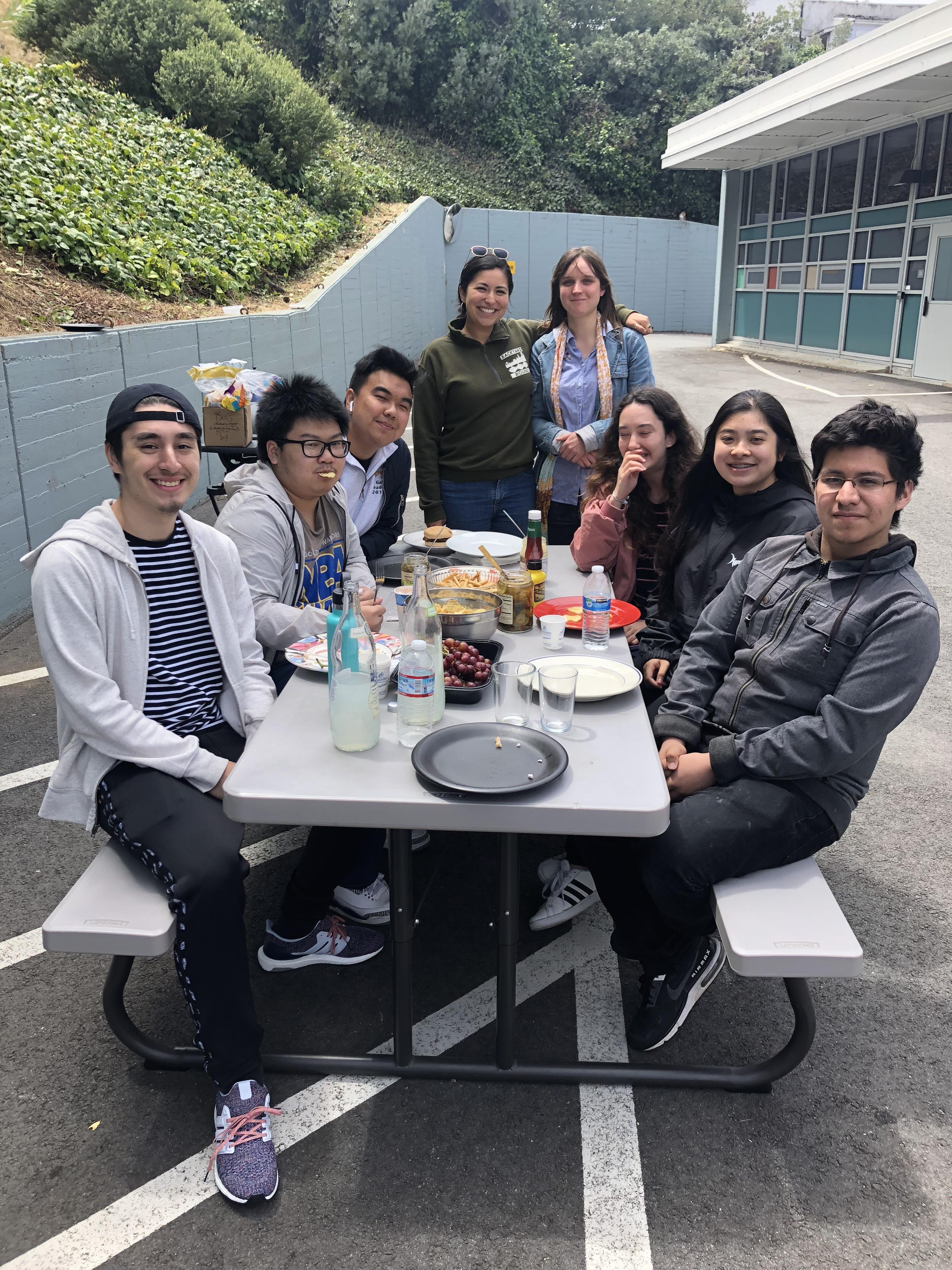
Julian Rodriguez, Jiahao Chen, Andy Xie, instructor Marisol Medina Cadena, instructor Holly J. McDede, Zoe Burleson, Ashlee Nguyen, and Christopher Olvera celebrate their last day interning with the KALW news department.
This is a paid program for students in the San Francisco Unified School District. We’ve welcomed them to KALW for six years, now, and we’ve developed some great training techniques with the support of the Association for Continuing Education. Our instructors, Holly J. McDede and Marisol Medina Cadena (who graduated in 2018 from our Audio Academy training program), did an outstanding job helping the students feel comfortable, directing them through a structured learning process, and producing the stories they reported, which we’ll all be able to hear on KALW the first full week of August.
I had the chance to talk with the teenagers quite a bit this year, as they all took part in our morning conference calls to discuss the news of the day affecting the Bay Area. I also always dropped in to their classroom as they gathered to start their lessons. I was really struck by their engagement, focus, and camaraderie. It’s such a pleasure to be around motivated students!
It was our biggest high school internship program yet, with six students receiving direct instruction, and it was a huge success. But don’t just take my word for that! Check out what the students themselves had to say:
Zoe Burleson:
My experience at KALW was a good one. I didn’t think I would have so much fun during this internship. Everyone was very welcoming and friendly, albeit intimidating — especially during the conference calls. I learned so much in such a short amount of time, it’s crazy. I really pushed myself out of my comfort zone to talk to new people and to adjust to different situations. A giant thank you to everyone!
Jiahao Chen:
This summer went by really fast. I don’t even notice this is the last day of the internship. I really enjoyed making my own story, and I never thought about it. Also, I really like the people in KALW, because they’re really nice and friendly. It makes me comfortable to work in this environment. Last but not least, I really like the cats. I never saw a cat or any animals in my past internships. It’s pretty cool. Thank you for the support and the amazing opportunity.
Christopher Olvera:
Working at KALW over the past six weeks has been a great experience. It’s been very fun to explore all the aspects of radio production hands-on. I especially enjoyed the fact that all of the tools we used, such as the recorders and editing software, were all industry-standard — the types of tools that professionals in the field may use. I also enjoyed the independence that you get while working at KALW, because while other jobs may give you a specific task to accomplish, at KALW, the project you are working on is yours, and it is something that you want to be working on. Everyone at the station is very nice, and there’s definitely a greater culture found here than you would find elsewhere. I enjoyed my internship at KALW.
Ashlee Nguyen:
To be honest, I didn’t expect to be doing work like this, meaning having work that has so much involvement. Whenever I go to the Friday classes, it’s always complaints on how they don’t do anything but shred papers or filing. Everyone complains while I’m sitting like, “Mine isn’t bad.” With writing a reflection in mind, my favorite parts were when we all came together and just talked, whether it be what we did over the weekend or recent news. It felt like we were just hanging out, and it made me feel closer to everyone.
Julian Rodriguez:
Having the opportunity to partake in this summer internship has truly been a blessing. I have learned so much, ranging from social skills, to tech skills, to learning about every one of the people around the building. Some of the highlights from this internship include: sitting in on the live conference call that took place; interviewing and meeting people around the building; and doing/completing my audio story. I am glad that I was gifted this experience and got to experience it with everyone I did. I felt like we all meshed well and all had different backgrounds along with personalities. That goes for everyone here at KALW; I feel like there’s a great blend of personalities and POV’s scattered throughout. Without this opportunity, I wouldn’t have learned a lot of the things about myself that I learned here. Overall, it has been an amazing experience, and I am very glad that I got to go on this journey along with you guys!
Andy Xie:
My summer here at KALW has truly been a spectacular one. I’ve learned so many things about radio journalism but still have so many more questions. Learning about recording techniques, such as room tone, where to aim the microphone, the settings of the microphone, and the levels were just some of the skills that I learned. I also got the experience of interviewing people, looking at how radio stories are made, from start to finish, and got to experience that myself with my own story.
KALW Brings the Magic of a Radio Storytelling Project to Solano Prison
By Eli Wirtschafter, KALW’s Transportation Reporter, Audio Academy class of 2016 and Manager of a new KALW training program
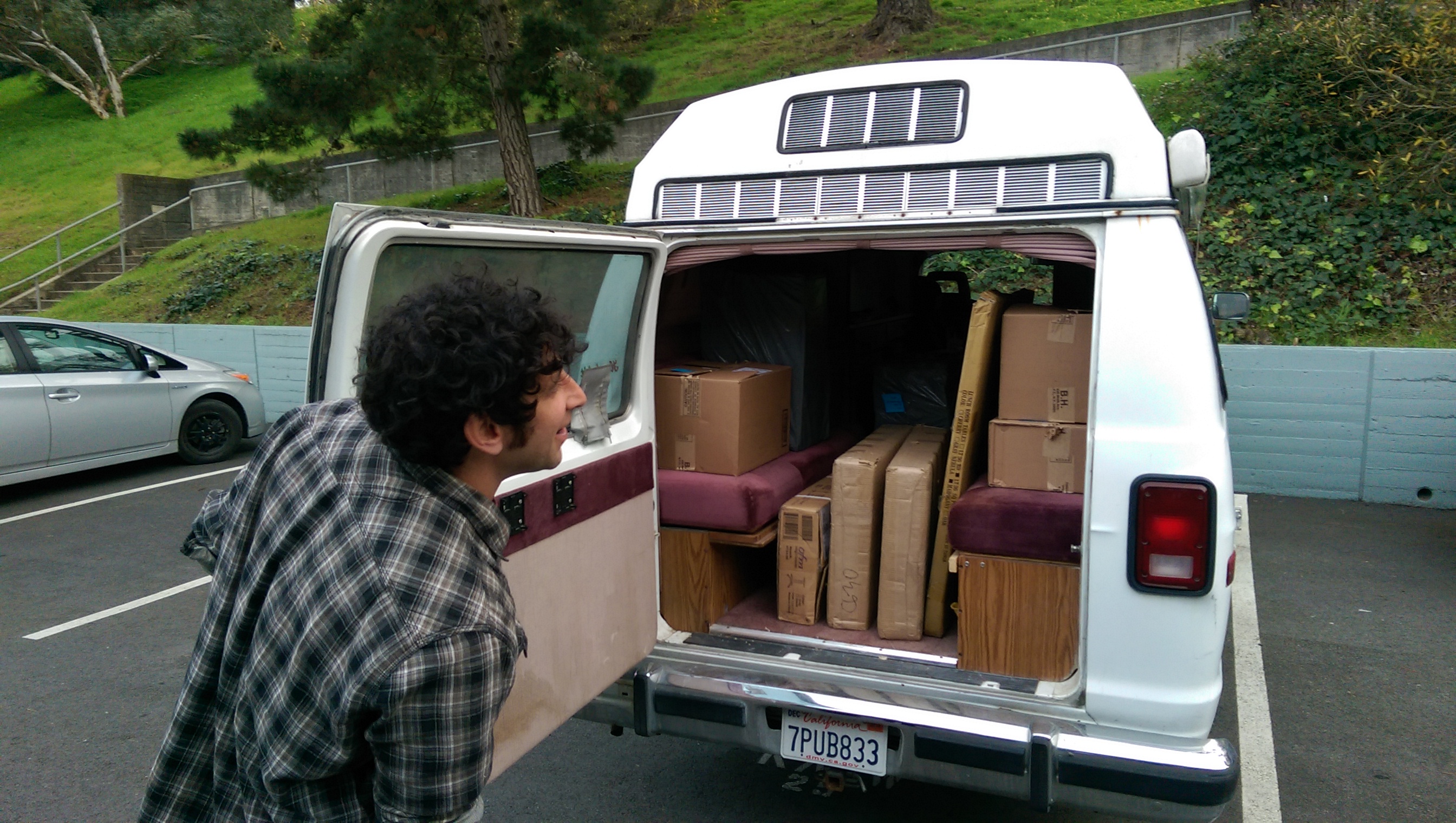
Andrew Stelzer loads equipment KALW purchased for the Storytelling Project into a van for delivery to Solano State Prison.
Since 2013, KALW has trained inmates at San Quentin State Prison in audio production, and aired their stories on Crosscurrents from KALW News. Now, the station is beginning a new project at Solano State Prison in Vacaville. The projects are made possible by a grant from the California Arts Council, with funding from the California Department of Corrections and Rehabilitation, along with support from the Association for Continuing Education.
One of the men in our class said he’d never seen a Mac computer before. He was incarcerated in 1978.
Another student has been locked up since the 1990s.
“I’ve missed the information age,” he told us. “I can’t believe I get to actually learn this stuff.”
KALW has donated three brand new Macs to the Solano State Prison as part of our new training program for incarcerated men there. With the help of prison staff, we set up the computers with Pro Tools, the audio editing software that’s the industry standard for both music and audio news production. We’ve transformed a tiny room in the prison’s education building into the institution’s first ever radio lab.
We have seven students. The group includes a poet, a software engineer, published authors, Shakespearean actors, toastmasters, newspaper writers, and a banjo player. They are the best students you could ever hope for: eager; ready to learn; and excited to start up a brand new project at the prison. They’re learning skills that one day they could use on the outside.
Over the next few months, the men will learn how to record audio interviews with other inmates. They’ll learn how edit those interviews on the computers we’ve brought in. A team of professional radio producers, including KALW producer Hannah Kingsley-Ma (Audio Academy class of 2015), KQED reporter and producer Jessica Placzek, KALW editor Andrew Stelzer, and myself, is going in about once a week to teach all the skills of interviewing, recording, and editing. We’re adapting the same curriculum we use to train fellows in KALW’s Audio Academy – the same program that trained me to be a radio producer.
As soon as the students’ pieces are complete, we’ll send them out of the prison and air them on KALW.
The stories the men at Solano will produce (at least at first) will be in a slightly different format from the feature stories that come out of our program at San Quentin. At Solano, the reporters will create pieces in the style of StoryCorps, the national oral history project. (StoryCorps was also a partner of ours during early stages of developing the project.) They’ll record long, intimate conversations and edit those conversations down to two to four minute radio gems. This work might be less technically complicated than producing a feature with many voices, but in some ways the editing challenge is even greater. You have to create a narrative arc using just a single conversation.
On the first day of class, we wanted to play the students an example of the kind of story they will produce. We chose a StoryCorps classic, a conversation between a woman and her devoted husband as he nears the end of his life. You can listen to it here.
It’s not easy to express vulnerability in prison. The men guard their emotions closely. Some talk about the masks they wear out on the yard. But as they listened to that story, we watched their masks melt away. With tears in their eyes, one man talked about the love his own parents had for each other. Another man talked about the love he hopes to feel once he leaves prison. They understood the magic of radio, how it can connect you with a stranger in just a few minutes.
Although Solano doesn’t have as many volunteer programs as San Quentin, they do have a lot of classes taught by other incarcerated men. It’s been awesome to see our seven students build a supportive culture for each other. The ones with the most computer experience are helping the others master completely unfamiliar technology.
They’re excited to learn a bunch of new skills, and they’re excited to get their stories out into the world.