
ACE Spectrum
ACE Spectrum
Ace Spectrum is about you — the ACE Learning Centers.
It’s a quick sharing of ideas, inspiration, opinions and best practices among our continuing education organizations.
Please join the conversation.
Audio Academy Alums Report On Helping Homeless and Making Snap Judgment at Standing Rock
By Ben Trefny, News Director, KALW Public Radio
The Oakland warehouse fire dominated our thoughts last week. Deep condolences to all the victims, their friends and families, along with the Bay Area arts community on the whole. Many of the people who take part in and work with KALW‘s Audio Academy are part of that community; personally, one of my son’s schoolmates from the Ruth Asawa School of the Arts in San Francisco died. As a news department and a voice of the community, we will cover the changes sure to come from what seems like an avoidable tragedy and support those who have been affected.
That event overshadowed much of the other news that took place in the Bay Area, but we were still able to air several impactful stories by Audio Academy alums:
– We aired a series of pieces this week about people living in San Francisco’s single room occupancy hotels. Colin Peden (’15) did a great job recording these stories as part of a larger project to be displayed at the San Francisco Public Library in January, and these provide touching insights to people living on the social and economic margins of our society. Here are links to those pieces:
SRO Stories: I traded reality for the gay closet
SRO Stories: Nothing can jeopardize my sobriety
SRO Stories: I’m adapting to being around other people
– On Wednesday, we took part in the Bay Area’s 2nd media day of homelessness coverage. That included a powerful feature from Liza Veale (’15) expressing how detrimental homelessness is on people’s mental health:
Mental health issues are often a consequence – not a cause – of homelessness
– We also aired a listener-generated Hey Area story — this one about the Bay’s water quality — from Angela Johnston (’14):
Hey Area: Meet the team who monitors the water quality in the Bay
It turns out the water quality is “better than it used to be.”
—
Check in with Academy alum Liz Mak (’14):
Liz was part of the first Audio Academy class, and after graduation she continued working with our news department as a reporter and as a line producer. Earlier this year, she took a job with the nationally syndicated weekly show Snap Judgment based in Oakland. Here are some of her thoughts:
I started at Snap Judgment 4 months ago, which has been stretching my storytelling skills in all directions. It’s rigorous here: The workload is heavy, the attention to detail minute, and the standard incredibly high. So I’ve been particularly mindful lately of how what I’ve learned at KALW over the last three years set me up well to do the work that I do now. While I’ve made my fair share of mistakes being new to the job, it’s given me a boost of confidence knowing that, while I may be learning more of the particulars of Snap Judgment’s way of storytelling, I have a strong background in the fundamentals in reporting and interviewing.
A few weeks ago, I was sent to Standing Rock to find a story. For me, it was both a challenging and daunting task to be sent on my own and to come back with a story that fit Snap Judgment’s rather strict parameters. It was a challenging reporting environment, too, and in that time of pressure, I turned to my training from KALW — reminding myself that I’ve been sent to new environments countless times to speak with strangers and find their stories. It proved to be one of the most formative reporting experiences I’ve ever had. I’ve been learning that getting better as a storyteller and reporter doesn’t rely so much on gaining new skills as building on the fundamental ones I started nurturing from the beginning, at KALW.
—
Thoughts from current Academy fellow Claire Stremple:
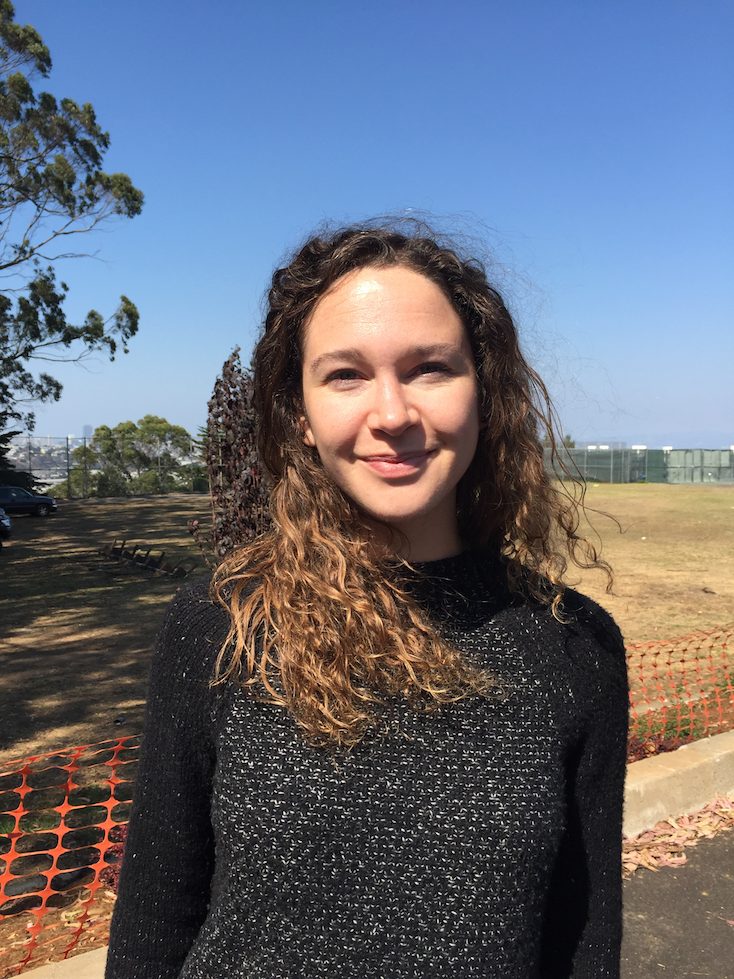
Current Audio Academy Fellow Claire Stremple.
Fledgling reporters rarely get so much attention as they do at KALW. Not that we’re coddled — the producers and engineers here are always busy working on pieces that seem to win awards on a weekly basis — but they always have time to answer even trivial questions. I think each of us fellows came to the Academy with a lot of ideas, and then found ourselves in a room surrounded by people in the business of turning ideas into actual things, and who approach that wild process with the calm, perfunctory manner of family doctors listening for a heartbeat first at the chest and then at the back. Or at least that’s how it looks from where I sit. Week by week, they pull back the curtain to reveal the complex mechanisms of reporting and storytelling. And each time a new process is uncovered, they approach it with the respect due to its difficulty, but a familiarity which lets us, sitting ankle deep in the baptismal waters of public radio, know that it’s not only possible, but imminent, and that we will do this thing, too, and soon. This week I sat with my mentor James in front of a screen that had my somewhat hacked-up edits of an interview on it. He listened, told me what he was thinking, and tightened up my work. Then he undid it, and let me do it with my hand, asking me if I heard the difference. I did. It was like reaching for something on a high shelf and getting an unexpected boost from behind. It sounded like I’d imagined it could.
The KALW Audio Academy Progresses on Learning How to Make Audio Conversations
By Ben Trefny, News Director, KALW Public Radio
The Audio Academy is currently working on a group project to report stories about the Portola neighborhood just down the hill from KALW. First draft scripts are due in the next few weeks, and the pieces should be airing near the start of 2017.
Meanwhile, several Academy fellows have produced some nice pieces outside of the assignment base:
Josiah Luis Alderete and I reported this story about the closing of the iconic Modern Times bookstore in San Francisco’s Mission District.
Jeremy Jue, Cari Spivack and Boawen Wang helped me make this documentary contextualizing Colin Kaepernick‘s protests of police brutality during the playing of the National Anthem. Specifically, Jeremy made this non-narrated piece about the Oakland Unified School District Honor Band taking a knee while playing the anthem, and Boawen and Cari spoke with people at Mission High School and Castlemont High School to talk about how Kaepernick’s statements have affected their football teams.
This week, we’ll teach a seminar on voicing. Recent weeks have focused on audio engineering and writing for radio. By the end of 2016, the fellows should have the complete set of basic skills in place, ready for production on their Portola series.
—
Check in with Academy alum Todd Whitney, who, among much other work produced at KALW, made a show about the concept of raising the minimum wage to a real living wage:
I did KALW’s Audio Academy from 2013-2014, then I leveled up as a reporter/producer until July 2015.
I’ve been a producer at Audible since January 2016. It’s been a good experience so far in that I’m working on projects that are really different from the work I produced at KALW, but I’m deploying many of the same skills. The primary project I’m working on is an audio documentary on Bernie Madoff and the fallout for his victims after his 2008 confession. The project is so dissimilar from any of the issues I reported on at KALW, but the tenacity it takes to report/produce a story for over a year is something I harnessed in multiple stories while working at KALW. The good stuff takes time to develop.
—
Thoughts from current Academy fellow Jeremy Jue:
I’ve been thinking about community a lot lately, what a healthy community looks like and how it is formed, and after three months as an Audio Academy fellow I can honestly say that the community formed at KALW is a fantastic model. The team here is diverse, committed, and intentional with the stories that they report. They bounce ideas off of one another, share information freely, and make a conscious effort to provide voice to the people of the San Francisco Bay Area. In doing so, they have created a culture of collaboration and joy. A place where it is clear that everyone who works here cares deeply about their work, but also about one another. This makes for an incredibly welcoming environment. It is also a great place to grow.
As I grow, and continue my journey with KALW, finding and developing my own voice, I am grateful for the nurturing environment that this community provides. Even when I am challenged by a task or assignment, I always feel safe. Safe to ask questions, and safe to share my insecurities and anxieties without feeling judged. This type of exchange helps immensely. It builds my confidence, makes feel supported, and often times helps me find my focus so that I can contribute in a more impactful way.
In conclusion, I am excited to have the opportunity and be a part of the KALW Audio Academy. I am inspired by the people I work with and the community that they have formed. With their help and guidance, I look forward to producing stories that inform, represent, and generate conversations in the community we all call home, the San Francisco Bay Area.
The SF International High School ACE Learning Center Supports CCSF Students
By Kyle Halle-Erby, Span Program Director, San Francisco International High School
City College of San Francisco is the largest community college in California. The campus has dozens of academic programs that lead to Associate’s degrees and transfer to a UC, CSU or private university. In addition, the campus is rich with career development pathways focused on gaining certificates in many different fields, including child development, biotechnology and construction. Although CCSF offers many excellent support services, fewer than 1 in 5 students completes achieves his or her academic goals within four years.
It is easy to cast blame on CCSF. However, City College primarily serves students with great educational needs. They are students who are leaving high school with limited math and English skills, or who are returning to school after a long absence. They are students who are working full-time while they are studying, raising children or new to the country. Overwhelmingly, they are students who have struggled in the past in school and who need many supports – both academic and non-academic – in order to succeed.
This is where the ACE Learning Center at SF International comes in. This year, our learning center is partnering with CCSF to teach a course on campus to recent SFIHS graduates who are beginning at CCSF. The course is called “College Success Basics” and it focuses on supporting new students at CCSF. The course is designed to provide administrative, social, academic and language support for our students. So far, the course has felt very successful, but don’t just take it from me. Here are some excerpts from students’ mid-term course evaluations:
In this class Leti and Kyle are very helpful and they try to support you in everything. I feel that someone really cares about my education and supports me.
I like that this class is a place to talk about our problems and think of solutions.
In the future we should have this class more days each week.
Next year, you should include students from different schools as well so they can have this experience and we can meet new people.
Thanks to ACE and our partners at CCSF, we have been able to drastically improve our recent graduates on campus at CCSF.